News
Bank of England Raises Rates to 4%, First Rise Since 2023
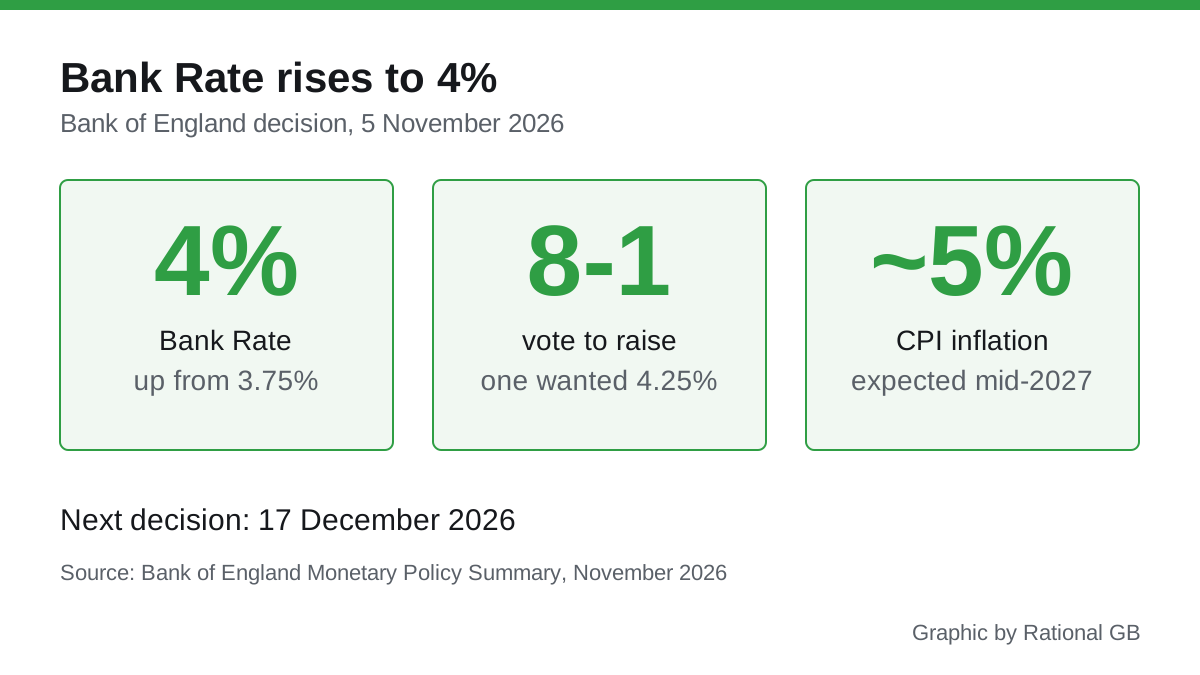
The Bank of England raised Bank Rate from 3.75% to 4% today, 5 November 2026, its first increase since August 2023, and this page covers that and three other changes from the past week. The others: the government has set out how pension schemes will have to offer a ready-made retirement income, it plans a simpler way for families to reach Child Trust Funds held by young adults who lack mental capacity, and the FCA has said what car finance lenders must do if they offer compensation early.
Bank Rate rises to 4% as inflation heads for about 5%
The Monetary Policy Committee voted 8-1 at its meeting ending on 4 November to raise Bank Rate by 0.25 percentage points to 4%. The one dissenter, Catherine Mann, wanted a bigger rise, to 4.25%. Bank Rate had been 3.75% since December 2025. The reason is energy: the Bank’s Monetary Policy Summary says the conflict in the Middle East is in its ninth month, CPI inflation was 3.5% in September and is now expected to rise to around 5% by the middle of next year before falling back. The Committee says it has seen limited knock-on effects on other prices and wages so far, but enough pressure in the pipeline to justify the rise. The next decision is due on 17 December 2026.
For savers, variable rates on easy-access accounts and cash ISAs should start to move up, but banks pass on rises at their own pace, so check your rate rather than assume. With inflation forecast to outrun most savings rates next year, cash in a taxable account loses ground twice: to prices, and to the higher savings tax rates due from April 2027. For borrowers, tracker and variable mortgages follow Bank Rate directly. Fixed deals were already repricing: the minutes note that benchmark two-year mortgage rates had risen by nearly 50 basis points since the start of September. If you are weighing spare cash against the mortgage, our overpay or invest calculator lets you put in your own rates, and cash ISA or stocks and shares ISA covers where money for five years or more is better kept.
One smaller knock-on: HMRC’s Save As You Earn bonus rates rise for new contracts starting from 20 November 2026, to 0.5 monthly payments over three years and 1.5 over five. Existing SAYE contracts are not affected.
Pension schemes will have to offer a default retirement income
The Department for Work and Pensions, the Treasury, the FCA and The Pensions Regulator published a guided retirement consultation on 3 November. Under the Pension Schemes Act 2026, workplace defined contribution schemes will have to present savers with a pre-selected “default pension” when they come to take their money, instead of leaving them to choose between drawdown, an annuity or cash on their own. The default has to pay an income for life, and the consultation says drawdown alone cannot do that, so expect some form of longevity protection, such as an annuity for part of the pot, built in. You will still be able to opt out, and schemes must try to contact you before any irreversible step is taken. The indicative compliance date for master trusts and FCA-regulated schemes is summer 2029, and the consultation closes on 22 December 2026. Nothing changes for anyone retiring before then; drawdown versus annuity explains the choice the default is meant to simplify.
Families to get easier access to Child Trust Funds for young adults lacking capacity
The government said on 3 November that it will change the law so that parents and carers of young adults who lack the mental capacity to manage money can go straight to the Child Trust Fund provider, rather than through the Court of Protection. It estimates 63,000 to 126,000 young adults are affected, with accounts worth £2,600 on average. An amendment to the Financial Services and Markets Bill will enable the scheme, with the detail in secondary legislation, so there is no start date yet. The Court of Protection route stays available. Child Trust Funds were replaced by the Junior ISA for children born from 3 January 2011.
Car finance lenders may offer compensation before the legal challenges end
The FCA set out on 3 November what lenders must do if they make settlement offers to people owed money under its motor finance compensation scheme, which is partly suspended while legal challenges are heard between 16 February and 3 March 2027. Barclays Partner Finance has confirmed it will make offers to some customers. Any offer must be no less than the scheme would pay. If you accept, you keep the money even if the court cases would have cut your award, but you cannot claim more if they would have raised it. You can refuse and wait for the scheme, and these offers cannot be taken to the Financial Ombudsman. The FCA will list lenders making offers on its website so you can check one is genuine. If you have not complained yet, complain to the lender directly; there is no need to use a claims firm, which may take up to 36% of any payout including VAT.