News
Jarvis Investment Collapse: Clients Hear Within 8 Weeks
An investment firm that holds shares and cash for clients of advisers and wealth managers has gone into special administration, September’s inflation figure has settled what the state pension triple lock points to for April, and the FCA has banned a chief executive who fronted a firm selling mini-bonds. The first is a test of how platform protection works in practice; the last is a reminder of what it does not cover.
Jarvis Investment Management has entered special administration
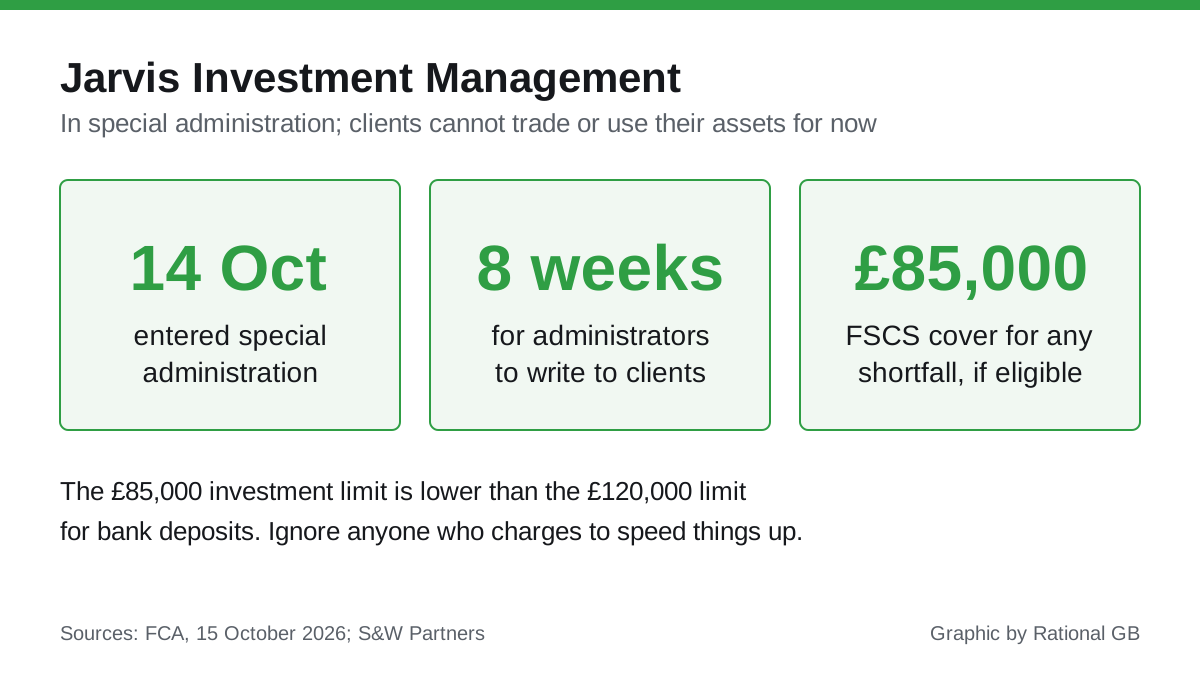
The FCA said on 15 October that Jarvis Investment Management Limited entered special administration on 14 October, with Adam Stephens and Philip Hemming of S&W Partners appointed as special administrators. Jarvis is authorised to provide wealth management services, and had been operating since September 2022 under a voluntary requirement with the FCA that restricted what it could do without the regulator’s consent. Clients cannot trade or use the cash and investments held with it while the administrators check the position, and the administrators will write to every client within eight weeks of their appointment to explain how money and assets will be returned and how to claim.
If any client money or investments turn out to be missing, the Financial Services Compensation Scheme may cover the shortfall for eligible clients up to £85,000, and may also cover the costs of returning assets, which could otherwise be taken from client funds. Note that this is the investment limit: the higher £120,000 limit applies only to bank deposits. S&W says a redress programme Jarvis had been running until 23 December 2026 has stopped; anyone who had not submitted a claim before the administration may still qualify, but as an unsecured creditor, and the administrators are asking the FSCS whether unpaid redress can be covered. If your adviser or wealth manager uses Jarvis, speak to them first, and do not pay anyone who offers to speed up the return of your assets. Best investment platforms explains how platforms keep client assets separate. Sources: FCA and S&W.
September inflation was 3.5%, so the triple lock points to a 3.9% state pension rise
The ONS said on 21 October that CPI inflation rose to 3.5% in the 12 months to September 2026, up from 3.1% in August, with motor fuels the biggest upward push. September’s CPI is one of the three tests in the triple lock. The others are average total earnings growth for May to July, which the ONS put at 3.9% in September, and 2.5%. The highest of the three is earnings, so the triple lock points to a 3.9% rise in April 2027, which would take the full new state pension from £241.30 to £250.70 a week. The government confirms the figure in its annual uprating statement.
September’s CPI is also the figure most working-age benefits are normally raised by, which would mean a 3.5% rise for those from April. For savers the more immediate point is that inflation has risen for three months running: cash earning less than 3.5% before tax is now losing value in real terms. The state pension explained covers how it fits with private savings, and cash ISA or stocks and shares ISA covers where longer-term money goes. Sources: ONS, CPI September 2026 and ONS, labour market September 2026.
The FCA bans a chief executive who fronted for a disqualified director selling mini-bonds
The FCA said on 21 October that it had banned Jeffrey Dawkins, former chief executive of Vector Wealth Ltd, and fined him nearly £270,000. In 2019 he sold the firm to a director who had been disqualified for 12 years, but told the FCA he was still in charge, so the new owner could use the firm’s authorised status to promote mini-bonds. Investors had to say they were high net worth or sophisticated before seeing the marketing, put in £105,000 on average (one put in £1.1 million) and are expected to lose about £4 million. A former senior manager, Kadir Kanizi, has been banned from senior management roles and fined £20,000, reduced from £80,096 on hardship grounds.
Two lessons carry over. A firm being on the FCA register does not make everything it sells safe: mini-bonds are loans to a company, and if the company fails you can lose the lot, usually with no FSCS cover. And ticking a box that says you are a sophisticated investor removes protections rather than proving anything. Boring diversified funds are the better route for almost everyone; common investing mistakes covers the rest. Source: FCA.