News
Property Funds: FCA Plans 90-Day Notice to Withdraw Cash
The regulator has proposed the biggest change in years to how open-ended property funds work, HMRC has started its Self Assessment reminders, a broker has gone into special administration and the Treasury is closer to issuing its first digital gilt. Only the first two are likely to touch an ordinary portfolio, and only one has a deadline this month.
The FCA wants property funds to require 90 days’ notice for withdrawals
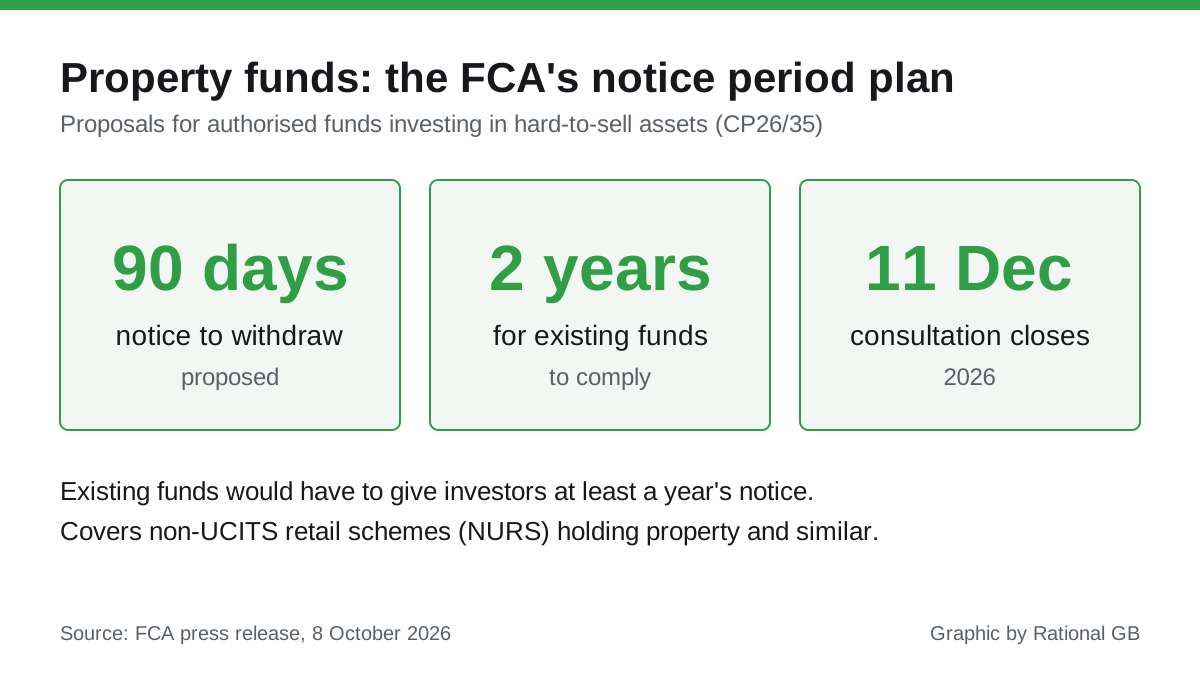
The Financial Conduct Authority published proposals on 8 October that would require investors in authorised funds holding hard-to-sell assets, such as property and infrastructure, to give 90 days’ notice before taking money out. The rules cover non-UCITS retail schemes (NURS). Some of these funds currently allow daily withdrawals, and the FCA’s concern is that in stressed markets they can run out of cash and suspend all payments, or hold extra cash that leaves less invested in the assets they are meant to own. Existing funds would get two years to comply and must give investors at least a year’s notice. The consultation, CP26/35, closes on 11 December 2026.
For investors, the point is honesty about liquidity. A fund that owns buildings cannot sell them in a day, so daily dealing was always a promise that could fail when it mattered most. If you hold a property fund in an ISA or pension, check its dealing terms; under these rules, money you might need at short notice should not be in it. Most people building a long-term portfolio do not need a direct property fund at all, and asset allocation and best global tracker funds cover a simpler core. Source: FCA.
Paper tax returns are due by 31 October, online by 31 January
HMRC’s Self Assessment reminder, published on 8 October, confirms the deadlines for the 2025 to 2026 tax year: 31 October 2026 for paper returns and 31 January 2027 for online returns and payment. If you also have PAYE income and file online before 30 December, tax owed can be collected through your tax code instead of as a lump sum. About 300,000 people who pay the High Income Child Benefit Charge through Self Assessment will find Child Benefit details already filled in on their online return.
For investors, the return is where dividends, interest and capital gains outside an ISA or pension get declared. If you are regularly filling in those boxes, that is the case for using your ISA allowance first; tax-efficient investing sets out the order, and ISA allowance 2026 has the limits. Source: GOV.UK.
Broker ITI Capital has entered special administration
The FCA said ITI Capital Ltd, a brokerage that held shares and bonds for clients, entered special administration on 25 September, with Duncan Perring and David Soden of Teneo Financial Advisory appointed. ITI Capital had agreed in August 2025 to stop most regulated activity and to stop taking new client money or custody assets. The administrators will write to clients within eight weeks explaining how money and assets will be returned and how to claim. Distribution costs may be deducted from client assets if there is not enough to cover them, in which case the FSCS may meet those costs for eligible clients, and it may cover a shortfall up to £85,000. That is the investment limit; the £120,000 limit applies to bank deposits.
Client assets at a platform are held separately from the firm’s own money, which is why a failure usually means delay rather than loss. The FCA also warns that the firm’s details are being used by a clone, so hang up on anyone who cold calls claiming to be ITI Capital, Teneo or the FCA and ring back on the official numbers. Best investment platforms covers what to check before choosing where your money is held. Source: FCA.
The Treasury has picked six banks for its first digital gilt
HM Treasury said on 6 October that Barclays, HSBC, Lloyds, Morgan Stanley, NatWest and RBC Capital Markets will be joint lead managers for the pilot issue of DIGIT, the UK’s first digitally native government bond. It will be short-dated, settled on a distributed ledger inside the Digital Securities Sandbox, and kept separate from the government’s main debt programme. Issuance is expected by the first quarter of 2027.
This is a wholesale market experiment, not a product for savers, and it changes nothing about the gilts or gilt funds you can already buy on a platform. It is worth knowing about mainly so you can recognise a scam that borrows the name. Stocks versus bonds explains where government bonds fit in a portfolio. Source: GOV.UK.